
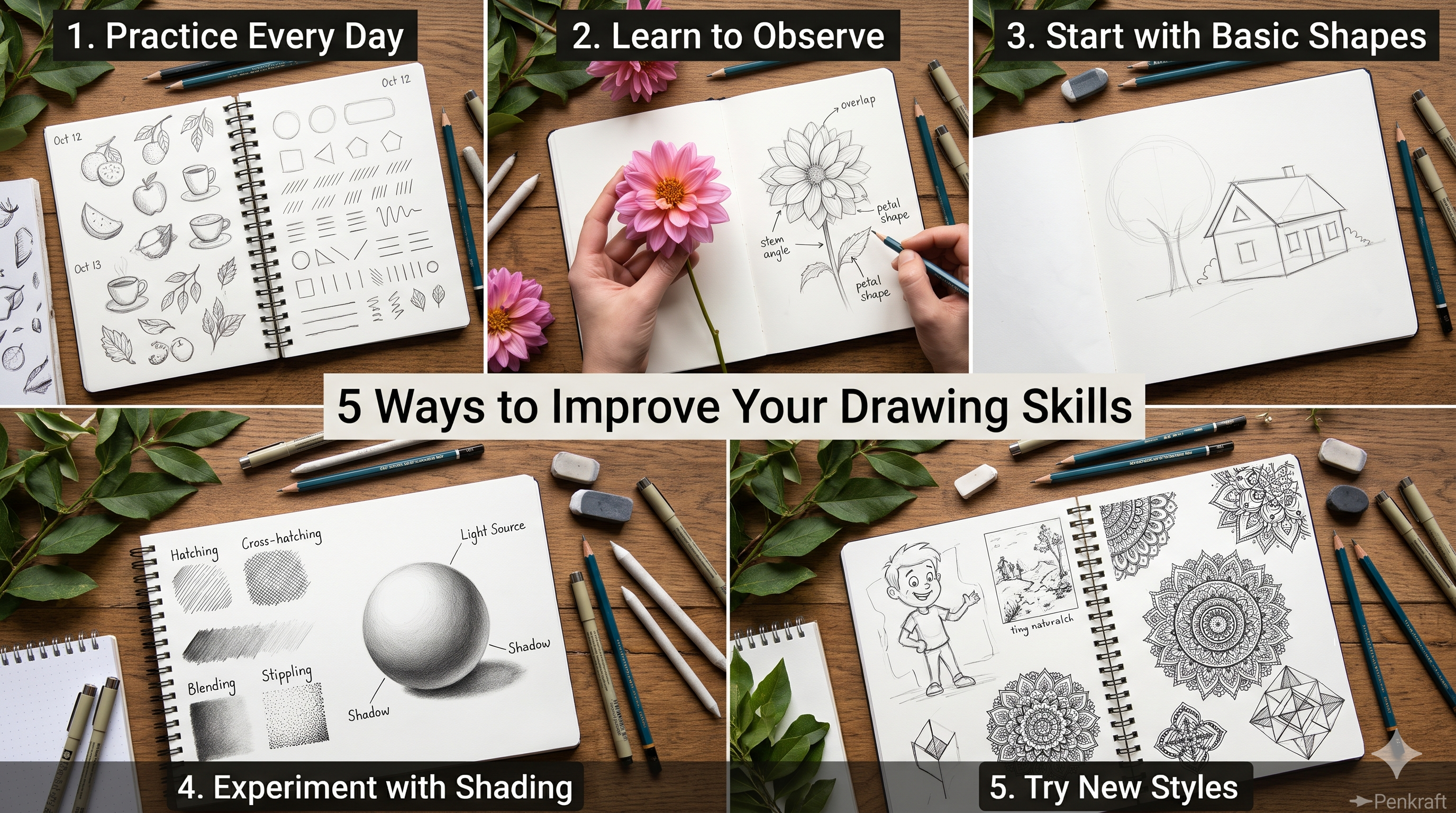
5 Easy Ways to Improve Your Drawing Skills :
Have you ever looked at a blank sketchbook and felt inspired, only to struggle when your pencil hits the paper? Drawing is a wonderful form of self-expression and creativity, but many beginners find it frustrating when their drawings don’t match what they imagine in their minds.
What if you could develop your artistic abilities faster with simple, actionable habits? Whether you are picking up a pencil for the first time or looking to refine your creative techniques, improving your drawing skills is entirely achievable with consistency and the right approach.
📌 Quick Navigation
Why Practice Matters in Drawing
Artistic skill is not just an innate talent; it is a learned ability built through observation, muscle memory, and regular practice. Just like learning an instrument or a sport, training your hand-eye coordination helps you translate real-world objects and imaginative concepts onto paper accurately.
💡 Looking for structured guidance? Explore professional creative courses and certified art programs at Penkraft to sharpen your techniques under expert mentorship. (Note: While Penkraft is widely known for skill-building, they offer diverse hobby and art workshops!)
5 Easy Ways to Improve Your Drawing Skills
Let’s explore five practical techniques that can help you elevate your drawing abilities.
1. Draw Daily
Consistency is the single most important factor in becoming a better artist. You don’t need to spend hours every day—just 15 to 20 minutes of regular sketching builds confidence and muscle memory.
-
Keep a small sketchbook and a pencil with you wherever you go.
-
Sketch simple household objects, hands, or quick doodles to keep your creative momentum alive.
2. Observe Light and Shadow
The secret to making a flat drawing look three-dimensional lies in shading. How light hits an object creates highlights, midtones, and cast shadows.
-
Pay attention to where the light source comes from in your reference or setup.
-
Practice gradual shading scales, moving smoothly from dark shadows to bright highlights using different pencil grades (like 2B, 4B, or 6B).
3. Practice Gesture Drawing
Gesture drawing is a quick, loose way to capture the action, form, and pose of a subject without getting bogged down by minor details.
-
Set a timer for 1 to 2 minutes and try to sketch a living subject or dynamic pose with fluid lines.
-
This trains your brain to see the overall flow of a subject rather than overthinking individual lines.
4. Use Basic Shapes First
Every complex object in the world—whether it’s a human face, a car, or an animal—can be broken down into simple geometric shapes like circles, rectangles, triangles, and cylinders.
-
Start your drawing by lightly sketching foundational shapes to map out proportions.
-
Refine and contour the outer lines afterward to bring your detailed subject to life.
5. Experiment with Techniques and Materials
Don’t be afraid to step out of your comfort zone. Trying different tools and styles can unlock new perspectives.
-
Experiment with charcoal, ink pens, colored pencils, or digital tablets.
-
Try blind contour drawing (drawing without looking at the paper) to improve your observational coordination.
How to Build a Creative Daily Habit
To get the best results from your drawing practice, keep these tips in mind:
-
Start small: Don’t pressure yourself to draw a masterpiece every day; focus on small sketches.
-
Keep your tools accessible: Leave your sketchbook on your desk or table so you feel invited to draw whenever you have a spare moment.
-
Review your progress: Date your sketches so you can look back months later and see how much your skills have evolved.
Conclusion
Improving your drawing skills takes time, patience, and regular practice[cite: 4]. By committing to daily sketching, mastering basic shapes, observing light, and trying new techniques, you can watch your artistic confidence grow.
Start sketching today, embrace your mistakes as part of the learning process, and take the first step toward unlocking your full creative potential!
Penkraft conducts classes, courses, online courses, workshops, teachers’ training & online teachers’ training in Handwriting Improvement, Calligraphy, Abacus Maths, Vedic Maths, Phonics and various Craft & Artforms – Madhubani, Mandala, Warli, Gond, Lippan Art, Kalighat, Kalamkari, Pichwai, Cheriyal, Kerala Mural, Pattachitra, Tanjore Painting, One Stroke Painting, Decoupage, Image Transfer, Resin Art, Fluid Art, Alcohol Ink Art, Pop Art, Knife Painting, Scandinavian Art, Water Colors, Coffee Painting, Pencil Shading, Resin Art Advanced etc. at pan-India locations. With our mission to inspire, educate, empower & uplift people through our endeavours, we have trained & operationally supported (and continue to support) 1500+ home-makers to become Penkraft Certified Teachers? in various disciplines.